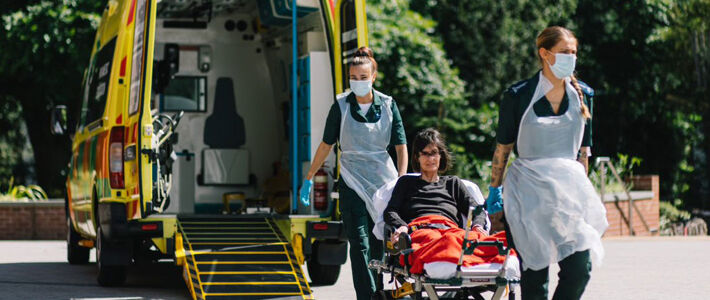
Paramedic Science - BSc (Hons)
Currently viewing course to start in 2027/28 Entry.
The BSc (Hons) Paramedic Science degree will develop your theoretical knowledge and practical skills within both the university and clinical practice environment. To be a paramedic you must be able to overcome challenges, show initiative and demonstrate critical thinking....
- Level Undergraduate
- Study mode Full Time
- Award BSc (Hons)
- Start date September 2027
- Fees View course fees
- Subject
- Location City South
This course is:
Overview
The BSc (Hons) Paramedic Science degree will develop your theoretical knowledge and practical skills within both the university and clinical practice environment. To be a paramedic you must be able to overcome challenges, show initiative and demonstrate critical thinking. This course will equip you with the skills and knowledge required to rise to these challenges, whilst developing your communication skills and knowledge.
All modules provide a balance between theory and practical application and provide the opportunity for you to reflect and apply context in clinical practice placements. This course is designed to be a catalyst for students to apply for registration with the HCPC and develop a successful career as a paramedic.
What's covered in this course?
To be a modern paramedic, you must overcome challenges, show initiative and demonstrate critically adaptive thinking, excellent communication skills and medical knowledge as the first point of contact in care provision for patients in stressful situations.
Becoming a professional modern Paramedic you'll need to be able to think critically, react appropriately in challenging and stressful situations, have effective communication skills and also have the knowledge and skills to deliver health care across the life span. You need to be able to do all of this whilst demonstrating empathy and care towards your patients and ensure your values and professional behaviour meet those required of HCPC to become a modern paramedic.
You will also become an effective member of the Paramedic profession by developing your medical and healthcare knowledge as well as clinical decision making skills and focusing on high quality patient centred health care. This will prepare you with the many possible career opportunities for the modern paramedic across settings such as clinical practice, education or research settings.
Where will I study?
You will study in our recently extended £71 million City South Campus, with access to cutting edge facilities and equipment that will enhance your skills learning. You will have access to advanced simulation facilities and environments that can re-create an emergency setting, allowing you to develop your hands-on skills right here on campus too. Our unique facilities are also useful to support you with any questions or queries before starting you real-life work placements.
See what our students say
Accredited By
This course is accredited by:

Simulations at University use Sim Man; you can feel for pulses, it talks and breathes so you can treat it as an actual patient. It gives you more confidence when doing your first patient assessments.
Shaun Kemp
Why Choose Us?
- Funding - Allied health profession students will receive at least £5,000 a year in additional funding for maintenance and associated study costs.ÌýDownload the funding FAQs
- Clinical experience - you’ll spend a significant period of time gaining experience, building confidence and skills in clinical placements in a variety of environments.
- You’ll learn though a variety of teaching methods, including simulations in our extensive skills facilities, such as ourÌýSPACE learning facilityÌý(Skills Practice and Care Enhancement), home environment and mock ward spaces using a range of kit including manikins that can ‘breathe’, talk and display a range of symptoms.
Open Day
Join us for our next Open Day where you'll be able to learn about this course in detail, chat to students, explore our campus and tour accommodation.
Next Open Day: 21 November
Course in Depth
Year One
In order to complete this course, you must successfully complete all the following CORE modules (totalling 120 credits).
The aim of this module is to ensure you have the knowledge and ability to provide the fundamental, quality and compassionate care expected from a functioning member of an ambulance crew providing emergency and urgent assistance in the out-of-hospital setting.
During taught sessions within the University, you will learn about the anticipated physiology and clinical parameters of service user groups encountered by the ambulance service and how to identify when these deviate from expected norms, through patient assessment and examination. From the information gathered you will learn to participate with the treatment and management of a variety of emergency and urgent presentations.
This module will provide you with the opportunity to explore different models of health and care. It will provide you with the different expectations and philosophies of care, and provide insight into health promotion and health education, and how this relates to pre hospital care. Strategies will also be introduced in terms of self-care for the practitioner, as well as any risk reduction practices when dealing with service users, family members and bystanders.
The module will also introduce you to the importance of teamwork and the need for multi disciplinary working, both within the NHS and wider pre-hospital arena.
This module provides a comprehensive foundation in human anatomy, physiology, and introductory pathophysiology across the major body systems. It is designed to support students in developing a systematic understanding of the structure and function of the human body, forming a basis for further study in health and related disciplines. Students will demonstrate knowledge and understanding of fundamental anatomical structures within each body system and describe the associated physiological processes that maintain normal body function.
The module also introduces core pathophysiological concepts, enabling students to develop insight into alterations associated with common conditions and to recognise how disruptions in homeostatic mechanisms contribute to disease. Throughout the module, emphasis is placed on integrating structure, function, and dysfunction to promote a holistic understanding of human biology.
On completion of this module, you will have been introduced to the professional and academic skills required to begin identifying and developing the requirements needed to study on a paramedic course. It is expected that as an aspiring registrant with the Health and Care Professions Council (HCPC), you will have an understanding of professionalism and evidence-based practice and be able to apply these principles to your practice. You will further develop your academic writing and reflection skills to aid in your progression both as a student and future registrant.
As a Health Care Professional, you will need to deliver a person-centred care approach to every service user you encounter. This means providing care that is respectful of, a response to individual preferences, needs and values. In order to do this you will be introduced to the importance of care and compassion in relation to holistic patient care. You will also discuss the importance of social prescribing and making every contact count.
This module will allow you to work towards achieving the competencies outlined by the College of Paramedics’ Curriculum Guidance and the Health and Care Professions Council Standards of proficiency: Paramedics. The Clinical Practice modules at 91ÁÔÆæ are based on the core values of pursuing excellence, interdisciplinary, employability and are practice-led in a professional environment.
Furthermore, they directly embody the programme philosophy and aims. Through a work based learning style approach this module credits the learning of clinical and non-technical skills while on the first year of placements and ultimately developing you towards an “industry ready� practitioner.
Year Two
In order to complete this course, you must successfully complete all the following CORE modules (totalling 120 credits).
The need to reason independently and critically is paramount to providing a safe and effective service to service users, especially in challenging circumstances. This module aims to allow you to explore, develop and practice the skills necessary to respond effectively and professionally to complex and high-pressure situations. The clinical progression in paramedic practice module links and draws together the knowledge learnt in other level 4 & 5 modules, allowing for subject knowledge to be applied in both simulated and clinical practice, developing you towards an ‘industry ready’ safe and effective practitioner.
This module provides a comprehensive understanding to human anatomy, physiology, and pathophysiology, designed to develop students’ understanding of the structure, function, and dysfunction of the human body across all major body systems. Students will develop on level 4 knowledge of anatomical structures, including their organisation, relationships, and functional roles, and will explore the normal physiological processes that sustain life.
Building on this foundation, the module examines the pathophysiological mechanisms underlying a range of common medical and traumatic conditions, enabling students to understand how disruptions to normal physiology and homeostasis contribute to disease development and progression.
The purpose of this module is to support students in developing their understanding of how health and ill health evolve across the life course paying particular attention to common health determinants.
Throughout the module there will be significant emphasis on life course epidemiology including the social and economic determinants of health, the role of race and ethnicity, digital literacy and exclusion, and an appreciation of complex gender disparities. The module advocates for an evidence-led approach to pre-hospital care nurturing confident learners with an appreciation of structural competency rather than a simple cultural awareness. Participation in the module content supports learners in understanding how one’s experience at a particular life stage might significantly influence both the presentation of disease and an individual’s health outcomes in later life.
Knowledge for effective health care is developing at an unprecedented pace and your professional practice requires sound and reliably constructed evidence in order to maintain effectiveness. Service user safety and ensuring clinical effectiveness are critical issues in health care provision and the importance of evidence-based practice has never been greater. Evidence-based practice is central to the provision of optimum care, ensuring positive service user outcomes. Critical thinking is a core requirement of evidence-based practice and this will be enhanced through the development of evidence-based practice knowledge and skills. The importance and relevance of evidence-based practice has been recognised by the HCPC.
This module focuses on health inclusion a research and practice area addressing the extreme health inequalities as they are most commonly experienced by those at risk of structural health care exclusion. The module examines the immediate barriers to care. As the student you will acquire both clinical and advocacy skills required to provide high quality care for the aforementioned demographic. Particular attention will be given to groups such as those experiencing homelessness, Migrants, Sex Workers, The Prison Population and Travellers.
The ultimate goal is to transition you as the student from a descriptive understanding of marginalized cohorts to a critical synthesis of how structural failures necessitate professional advocacy and trauma-informed clinical intervention.
The Clinical Practice modules at 91ÁÔÆæ are based on the core values of pursuing excellence, interdisciplinary, employability and are practice-led in a professional environment. Furthermore, they directly embody the programme philosophy and aims. Through a work based learning style approach this module credits the learning of clinical and non-technical skills while on the second year of placements and ultimately developing you towards an “industry readyâ€� safe and effective practitioner.
Year Three
In order to complete this course, you must successfully complete all the following CORE modules (totalling 120 credits).
This module is designed to complete the healthcare professional’s journey through higher education, culminating in a significant independent piece of work. This module will utilise concepts and theoretical knowledge gained throughout the previous modules. The module will allow the discovery and synthesis of new information, allowing the student healthcare professional to independently work with the literature base and undertake a research project, which they may go on to conduct in continuing studies at level 7.
Engaging in research at this level is recommended by both the HCPC and professional body and may provide the student with the required knowledge and understanding to seek employment within the research field in their area of interest, which is requirement of the profession.
This module will help you develop the confidence and expertise to assess patients in complex and unpredictable situations. You’ll build on your existing clinical skills to perform advanced patient assessments, interpret findings, and make safe, evidence-based decisions in the pre-hospital environment. By completing this module, you’ll enhance your ability to think critically, communicate effectively, and justify clinical decisions under pressure — key skills for autonomous practice and leadership in the paramedic profession.
This module will deepen your understanding of human pathophysiology and pharmacology within the context of paramedic practice.
Your study will focus on the integration of disease mechanisms and pharmacotherapeutic interventions to support safe, effective, and evidence-based patient management across a range of pre-hospital settings. You will critically examine the physiological changes associated with acute and chronic illness and explore how these influence pharmacological response, clinical presentation, and treatment outcomes. As a result, completion of this module will ultimately develop you towards becoming ‘highly employable’ and an ‘industry ready’ autonomous clinician.
This module will focus on you as a developing professional with a specific focus on developing you as a leader. There will be an emphasis on the paramedic as a problem solver, leader, mentor and decision maker. You will also learn the importance of change management within the leadership process and within an organisation. Your study will focus on theories and processes within the NHS in terms of leadership, management and coaching. As a result, completion of this module will ultimately develop you towards becoming ‘highly employable’ and an ‘industry ready’ leader and team member.
This module will prepare you to provide safe, compassionate, and evidence-based care to paediatric and maternity patients in the pre-hospital setting.
You will develop upon pre-existing knowledge, learning anatomical, physiological, and psychosocial considerations that influence the assessment and management of these patient groups. You will be equipped with the skills and confidence to respond effectively to emergency and time-critical situations.
The Clinical Practice modules at 91ÁÔÆæ are based on the core values of pursuing excellence, interdisciplinary, employability and are practice-led in a professional environment. Furthermore, they directly embody the programme philosophy and aims. Through a work-based learning style approach this module credits the learning of clinical and non-technical skills while on the third year of placements and ultimately developing you towards an “industry readyâ€� safe and effective practitioner.
Download course specification
Download nowThis course gives you a balance of both the academic, evidence-based approach to health care but also the hands-on, real-world training you will need to enter this vital and fast-moving part of the health service.
In your first year, you'll be getting the fundamental knowledge and skills for paramedic practice, whilst your second and third years are about both developing and enhancing those skills to allow you work flexibly in various settings.
You'll learn via a carefully-designed mix of academic and clinical modules and a rolling series of practical placements, with a mixture of lectures and project work. The course is designed to help you become aÌýcapable, competent practitioner steeped in the ‘6 Cs’ values of the NHS Constitution and become employable after you graduate.
You'll also develop your research, leadership and clinical reasoning capabilities, while discovering the legal and ethical framework of today's healthcare culture.
You will spend time on placement as part of this course,Ìýwe are currently exploring new and exciting opportunities for placements.Ìý
Additional support
If you have a specific learning difficulty (such as dyslexia or ADHD), a disability, a long-term health condition or mental health difficulties, our support teams provide advice, information and practical support (such as reasonable adjustments). Engaging with our support teams early on in the application process means that the University is more likely to be able to implement support before your arrival at University. If you require reasonable adjustments in your placement setting, early disclosure will assist the University in securing suitable placements wherever it reasonably can.

Health and Care Professions Council
This course is approved by the , and will give you eligibility to apply for registration if you successfully complete the course.
Entry Requirements
These entry requirements apply for entry in 2027/28.
All required qualifications/grades must have been achieved and evidenced at the earliest opportunity after accepting an offer to help confirm admission and allow for on-time enrolment. This can also include other requirements, like a fee status form and relevant documents. Applicants can track their application and outstanding information requests through their 91ÁÔÆæ mySRS account.
Essential requirements
120 UCAS Tariff points. .
Applicants will also need to complete an interview for this course; see interview arrangements below.
Disclosure and Barring Service (DBS)Ìýand Occupational Health Clearance
Enrolment on the course is subject to:
- an Enhanced Disclosure & Barring Service check
- Occupational Health Clearance.
After the initial check, students will be required to self-declare and re-enrol each year.
If you have any queries, please refer to DBS Frequently Asked Questions,ÌýOccupational Health Clearance information or contact admissions@bcu.ac.uk.
It is important that you complete DBS and Occupational Health requirements as soon as possible once your offer is confirmed, to ensure that you have the necessary clearances in place before you start your course placements.
If you have a qualification that is not listed, please contact us.
Fees & How to Apply
UK students
Annual and modular tuition fees shown are applicable to the first year of study. The University reserves the right to increase fees for subsequent years of study in line with increases in inflation (capped at 5%) or to reflect changes in Government funding policies or changes agreed by Parliament. View fees for continuing students.
Award: BSc (Hons)
Starting: Sep 2027
- Mode
- Duration
- Fees
- Full Time
- 3 years
- £10,050 in 2027/28
International students
Sorry, this course is not available to International students.


Personal statement
The personal statement gives you a crucial opportunity to say why you’re applying and why the institution should accept you.
Here are the three areas you’ll need to address:
- Why do you want to study this course or subject?
Here’s where you explain what makes this course exciting to you. Think about your motivations for studying the course and your future plans. If you’re planning to take a year out, don't forget to give your reasons.
- How have your qualifications and studies helped you to prepare for this course or subject?
This is your chance to show what you’ve learned at school or college. You should include the skills and knowledge you’ve gained from education or training and how this will help you succeed in your chosen course.
- What else have you done to prepare outside of education, and why are these experiences useful?
Not everything you’ve learned comes from the classroom. Life experience counts too! You might want to talk about work experience, employment, or volunteering and how they’ve helped you develop the skills needed for your chosen course or future career.
Worried about Personal Statements?
If you've got no idea where to start or just want to check you're on the right track, we’ve got expert advice and real examples from our students to help you nail your personal statement. You can even download our ultimate personal statement guide for free.
Employability
Enhancing your employability skills
We are committed to developing Paramedic professionals who are capable of independent practice and also being members of interprofessional teams, while responding to the dynamic nature of professional practice.
After graduating from this undergraduate degree in Paramedic Science, you'll be eligible to apply for registration with the Health and Care Professions Council (HCPC).
The modern paramedic is faced with new challenges of working in a wide variety of situations traditionally staffed by other health professionals and our course reflects this changing picture. That means you'll be able to work in the NHS, as part of an ambulance crew, or in one of the many emerging roles; for example in a minor injuries unit.
The independent sector is also rapidly developing and actively seeks to employ HCPC paramedics; giving opportunities in areas across the UK and abroad. There is also a requirement for off shore installations and ships to have medics on board and UK paramedics are filling these posts and finding themselves working on oil platforms in the Middle East and ships ranging from pirate patrols to cruise ships.
If you want to stay closer to home, the TV and film industry, motorsport event and music festival organisers all have a need for paramedics to ensure that the crew and crowds remain safe and are well cared for in case of an emergency.
Placements
You will be required to travel anything up to an hour (travel time is calculated based on private vehicle, not public transport) from your term time address for your clinical placements. There is no guarantee of a placement in a specific area, and you may find it useful to be able to drive to placement. Unfortunately, we are not able to guarantee local placements for those who cannot drive.
It is important you appreciate that fees for accommodation and/or travel will require personal financial outlay; these may be reimbursable to some extent, the most up-to-date information can be found on theÌýÌýand the administrative team can also advise.
Facilities & Staff

Health Professions facilities
Take a look around the facilities available to you as a Health Professions student at 91ÁÔÆæ.
Our staff
Sharon Hardwick
Associate Professor Paramedic Science
Sharon has been a paramedic for over 20 years after starting her career with West Midlands Ambulance Service working in Coventry. In 2001 she became a clinical supervisor in what was Hereford and Worcester Ambulance Service, where she supported and mentored newly qualified staff through their training period.
More about Sharon