University News Last updated 14 February 2025
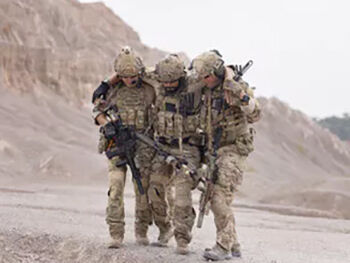
91ΑΤΖζ (91ΑΤΖζ) has welcomed a delegation of health and education professionals from Ukraine as part of an internationally significant project focused on improving treatment options for soldiers with complex eye injuries.
The visit to 91ΑΤΖζ and other institutions across the UK, supported by Blind Veterans UK, allowed the University to demonstrate the valuable role it is playing in the field of visual rehabilitation.
The National Institute of Health reports that there has been a since the beginning of Russia’s invasion of Ukraine, with nearly 20,000 cases of vision impairment reported since 2022.
This figure almost doubled within the first seven months of 2023, with many eye injuries attributed to the use of modern warfare technologies including mine explosions and rocket fire.
Philippa Cubitt, National Rehabilitation Services Lead at Blind Veterans UK said the two-week tour would prove extremely beneficial to Ukraine, which is still in the midst of a deadly conflict with Russia.
β€œOn top of the number of eye injuries we are seeing in Ukraine, the issue is being exacerbated because the rehabilitation and specialised educational workforce in Ukraine has not had access to this specific type of training,β€ she said, β€œour aim with this project is to support Ukraine to build their capacity and capability.β€
She added: β€œOver the two-week period, we gave an overview of the sight loss sector and services available in the UK, such as independent living training, rehabilitation services, back-to-work support schemes, service funding options, and charity partnerships.β€
Philippa said the project, funded by the World Health Organisation, would also have a direct impact on the treatment of British soldiers.
β€œThe complexity and nature of injuries incurred through modern warfare are different to those we have seen in recent years,β€ she said.
β€œThis project is providing us with invaluable insights into the effects of modern weaponry on individuals. Lessons learned from this process will ensure that we are ready to support the needs of British armed forces as and when needed in the future.β€
Susan Cadby, Senior Lecturer in Rehabilitation StudiesΜύat 91ΑΤΖζ, said: β€œThe sharing of this information is essential in improving the practical delivery of services to achieve the best possible outcome for people with sight loss.
β€œInternational visits are instrumental in fostering professional growth for the University and furthering our global presence and increasing collaborative opportunities in the future.β€
Professor Ian Blair, Pro-Vice-Chancellor and Executive Dean of the Faculty of Health, Education and Life SciencesΜύat 91ΑΤΖζ, said: β€œThis visit underlines our national and international impact in this area. It will recognise our contribution to visual rehabilitation at the highest level.β€